
Automation tool (Selenium) · Java
Selenium basics and browser control
WebDriver architecture, starting a browser, navigation and closing it.
Learn: Selenium basics in Java: how WebDriver works and controls the browser7 minute read
Selenium is a free, open-source tool (its code is public and anyone can use it) that controls a real web browser from code. Your test tells the browser what to do (open a page, click, type), and Selenium carries out each step. Almost every automation interview starts here, because everything else (locators, waits, frameworks) builds on it. The interviewer wants to see three things: you know what Selenium is and is not, you can explain how a command reaches the browser, and you can open and close a browser cleanly. This page covers Selenium 4 on Java 21.
What Selenium is made of
WebDriver is the API you call from your Java code. Selenium Grid runs browsers on other machines, so many tests can run at the same time. Selenium IDE is a browser extension that records and plays back clicks. Selenium Manager, included since version 4.6, finds or downloads the right browser driver for you.
Selenium is not a test framework. It has no assertions (checks that fail the test when a result is wrong, such as "the title must be Home"), no reports and no way to group tests. You pair it with a test runner such as TestNG or JUnit 5 (a library that finds your tests, runs them and shows the results), and a build tool such as Maven (a tool that builds your project and downloads libraries).
How a command reaches the browser
Take driver.findElement(By.id("user")). Four parts work together:
- The Selenium Java library (the client library, also called the language binding) turns the call into an HTTP request with a JSON body. HTTP is the way programs send requests over a network, and JSON is a plain-text format for data.
- The request follows the W3C WebDriver protocol. W3C is the body that writes web standards, and this protocol is the official way to control a browser. Selenium 4 sends its normal commands (find an element, click, type, read text) with this protocol. A few extra features, such as DevTools access (Chrome DevTools Protocol) and event listening (WebDriver BiDi), use a separate connection that stays open next to it.
- A browser driver receives the request. It is a small server program: chromedriver for Chrome, geckodriver for Firefox, msedgedriver for Edge.
- The driver tells the browser what to do and sends back a JSON response, for example an id for the element it found.
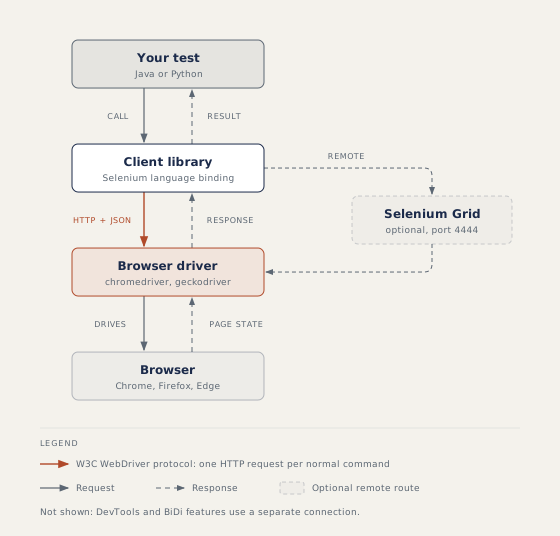
So findElement is one round trip and the click() after it is another. That is why good locators and well-placed waits matter: each extra lookup costs time.
WebDriver is an interface
An interface in Java lists methods without code; classes then provide the code. WebDriver is an interface. ChromeDriver extends ChromiumDriver, which extends RemoteWebDriver, the class that sends the HTTP calls. RemoteWebDriver also implements other interfaces such as JavascriptExecutor and TakesScreenshot. That is why you cast the driver to use those features: a cast tells Java to treat the object as that other type, for example ((TakesScreenshot) driver).
You declare the variable with the interface type, so the rest of the code does not care which browser it gets. A driver factory can later return Firefox, Edge or a RemoteWebDriver for Grid, and no test changes.
A first script, step by step
import org.openqa.selenium.WebDriver;
import org.openqa.selenium.chrome.ChromeDriver;
import org.openqa.selenium.chrome.ChromeOptions;

public class FirstScript {
    public static void main(String[] args) {
        ChromeOptions options = new ChromeOptions();
        options.addArguments("--headless=new", "--window-size=1920,1080");
        WebDriver driver = new ChromeDriver(options);
        try {
            driver.get("https://example.com");
            System.out.println(driver.getTitle());
        } finally {
            driver.quit();
        }
    }
}
- Create the browser settings with an options class (
ChromeOptions,FirefoxOptions). Headless means the browser runs without a visible window, which is normal on build servers (machines that run your tests automatically, with no screen). - Set a window size. The default headless window is small, and responsive pages may hide menus.
- Start the browser. Selenium Manager finds the driver if none is set up.
get()opens the page and waits until it has loaded.- Call
quit()in afinallyblock, so a failure never leaves a browser running. Afinallyblock runs whether or not an error happened in thetryblock above it.
Navigation and page details
driver.navigate().to(url) loads a page the same way as get(). The difference is only that navigate() also gives you back(), forward() and refresh(). Both add to the browser history. getTitle(), getCurrentUrl() and getPageSource() read the page. driver.manage().window().setSize(new Dimension(1024, 768)) sets the window size.
close() versus quit()
close() closes only the current window. If other windows are open, the session goes on, and you must switch to one of them before the next command. quit() closes every window, ends the session and stops the driver process.
How to answer in an interview
For "What is Selenium?", give one sentence of definition, name the parts, then one strength and one limit. For "Explain the architecture", walk the four parts in order and end with "each command is one HTTP round trip". If asked what changed in Selenium 4, mention the W3C WebDriver protocol (it replaced the old JSON Wire protocol), relative locators, switchTo().newWindow(), Duration timeouts and Selenium Manager.
Common mistakes
- Calling Selenium a testing framework. It only drives the browser.
- Saying
navigate().to()keeps history andget()does not. Both add to history. - Using
close()in teardown (the clean-up step after each test). Usequit(). - Forgetting the limits: Selenium cannot see operating system dialogs (windows opened by Windows or macOS, not by the web page), solve CAPTCHAs (the "prove you are human" puzzles) or test native mobile apps (apps installed on a phone; Appium does that).
Recap
Selenium drives real browsers, sending normal commands through the W3C WebDriver protocol. Your code talks to a client library, the library talks HTTP to a driver, and the driver controls the browser. Code against the WebDriver interface, configure the browser with an options class, and always end with quit().
13 questions0/13 solved
| Status | Question | Difficulty | Asked in |
|---|---|---|---|
| Not started | Open a browser, open a page and print its title | Easy | Asked in: Accenture, Capgemini, Infosys +3 |
| Not started | What is Selenium? Parts, strengths and limits | Easy | Asked in: Accenture, Infosys, TCS +1 |
| Not started | Visit two pages one after another | Easy | Asked in: Accenture, Infosys, TCS +1 |
| Not started | Go back and forward in the browser history | Easy | Asked in: Accenture, Infosys, TCS +1 |
| Pro+ | What kind of type is WebDriver in Java? | Easy | Asked in: Accenture, Infosys, Wipro |
| Pro+ | close() versus quit() | Easy | Asked in: Accenture, TCS, Wipro |
| Pro+ | Chrome is installed but there is no chromedriver. What happens? | Easy-Medium | Asked in: Accenture, Infosys, Wipro |
| Pro+ | Selenium WebDriver architecture in Java | Medium | Asked in: Accenture, Infosys, Wipro |
| Pro+ | What changed in Selenium 4 (Java)? | Medium | Asked in: Accenture, Infosys, Wipro |
| Pro+ | driver.get() versus driver.navigate().to() | Easy | Asked in: Accenture, Infosys, TCS +1 |
| Pro+ | Start Chrome headless with a fixed window size (Java) | Easy-Medium | Asked in: Capgemini, Cognizant, Infosys +1 |
| Not started | Set the browser window size and read it back | Easy | |
| Not started | Read the page source and search it | Easy |
The first 2 questions of each topic are free. Pro+ opens every question.