
Automation tool (Selenium) · Python
Grid, headless runs and tool choice
Selenium Grid, headless browsers, limits of Selenium and alternatives.
Learn: Selenium Grid, headless runs and tool choice (Python)7 minute read
Selenium Grid runs browsers on other machines, so a suite can run many tests at the same time and cover browsers and operating systems you do not have. Once tests run on your laptop, the next interview questions are about running them at scale and knowing when Selenium is not the right tool. Senior interviewers like this topic because good answers need judgement, not just API names.
Hub and nodes
The hub receives requests for new browser sessions and sends each to a suitable node. A node is a machine or container with browsers and drivers; more nodes mean more capacity.
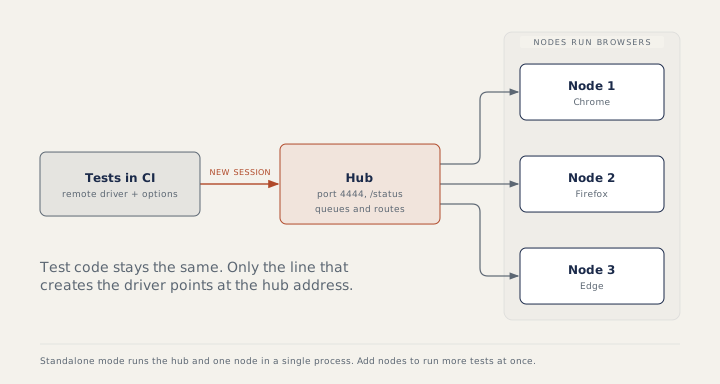
Grid 4 can run as standalone (hub and node in one process), hub and node, or fully distributed, where the hub's parts run separately. The quickest start is the official Docker image:
docker run -d -p 4444:4444 --shm-size="2g" selenium/standalone-chrome
Docker packages a program with everything it needs into a container, a small isolated environment, so you can start Grid with one command. Grid listens on port 4444 (a port is a number that tells the machine which program should receive the request), and http://localhost:4444/status says whether it is ready. In Docker Compose, depends_on only orders container start-up, so a CI script (CI, continuous integration, means a server runs your tests automatically after each code change) or health check should wait for /status before pytest starts.
Connecting from Python, step by step
from selenium import webdriver

options = webdriver.ChromeOptions()
driver = webdriver.Remote(command_executor="http://grid-host:4444", options=options)
- Create the browser options as for a local run.
- Create
webdriver.Remotewith the Grid address and the options. - Use the driver exactly as before; the API is the same.
The old desired_capabilities argument is gone and raises TypeError. In a pytest framework, the driver fixture reads a --grid-url option and returns webdriver.Remote(...) when it is set, otherwise a local browser. Uploads work on Grid without extra code, because webdriver.Remote uses a LocalFileDetector by default. Downloads need options.enable_downloads = True, then get_downloadable_files() and download_file().
Headless browsers
Headless means no visible window. Add options.add_argument("--headless=new"); it is normal in CI and containers. The default headless window is small, so set --window-size=1920,1080 or call driver.set_window_size. Screenshots still work, so failure evidence is not lost. Operating system automation tools do not work. Make headless a command-line option rather than hard-coding it, so you can watch the browser when debugging.
What Selenium cannot do
Selenium drives web pages. Native mobile apps need Appium. CAPTCHA and SMS OTP (a one-time password sent by text message) exist to stop automation; ask for a test-environment switch, provider test keys, a fixed test OTP or a test inbox API instead of trying to beat them. There is no built-in visual comparison: Selenium takes screenshots, and a separate library or service compares them with approved images.
Selenium, Playwright or Cypress?
Selenium implements the W3C WebDriver standard, with many languages, drivers from the browser makers, and Grid and cloud providers; waits and reports are your job. Playwright waits automatically before actions and has network mocking (faking server answers), tracing (a recording of each test step) and parallel workers built in, with Python, Java, JavaScript and .NET clients. Cypress runs inside the browser with fast feedback, supports JavaScript and TypeScript only, and makes multiple tabs awkward.
How to answer in an interview
Explain hub and node in two sentences, show the webdriver.Remote line, and say when Grid pays off: a slow suite, parallel CI runs or several browsers. For tool choice, decide by team language, browser coverage, the existing suite and CI. Saying that a working suite often gains more from better waits, fixtures and test data than from a rewrite shows practical judgement.
Common mistakes
- Passing
desired_capabilitiesfrom an old tutorial. - Starting pytest before the Grid reports ready.
- Running headless with the default small window.
- Trying to automate around a CAPTCHA.
Recap
Grid runs browsers remotely: the hub routes sessions to nodes on port 4444. Connect with webdriver.Remote(command_executor=..., options=...). Run headless with a fixed window size, know what Selenium cannot do, and choose tools by what the team needs.
10 questions0/10 solved
| Status | Question | Difficulty | Asked in |
|---|---|---|---|
| Not started | Selenium Grid: hub and node, and when you need it | Medium | Asked in: Accenture, Capgemini, Infosys |
| Not started | Connect a Python test to Selenium Grid | Easy-Medium | Asked in: Accenture, Capgemini, Infosys |
| Pro+ | Starting Selenium Grid | Medium | Asked in: Accenture, Capgemini, Infosys |
| Pro+ | Running the browser headless: what changes? | Medium | |
| Pro+ | Which argument starts Chrome headless? | Easy | |
| Pro+ | Can you automate CAPTCHA, OTP or barcodes? | Medium | Asked in: Accenture, Infosys |
| Pro+ | Selenium versus Playwright and Cypress | Medium | Asked in: Capgemini, Infosys |
| Pro+ | Mobile automation basics: how Appium works | Medium | Asked in: Accenture, TCS, Wipro |
| Pro+ | Grid address and readiness check | Easy-Medium | Asked in: Accenture, Capgemini, Infosys |
| Pro+ | Visual comparison tests and their traps | Medium-Hard |
The first 2 questions of each topic are free. Pro+ opens every question.