
Project and behavioural
Behavioural stories
Teamwork, conflict, mistakes and ownership, told with a clear structure.
Learn: Behavioural stories with STAR: conflict, mistakes, deadlines and learning7 minute read
Behavioural questions start with "Tell me about a time when...". The idea behind them is simple: how you acted before is the best guide to how you will act again. Product companies (which build their own software products) often use them in most rounds, and service companies (which build software for clients) mainly in managerial and HR rounds. A good answer is hard to invent on the spot, but you can prepare a small set of true stories that cover most questions, and tell each one with a clear structure.
The STAR structure
STAR stands for situation, task, action and result.
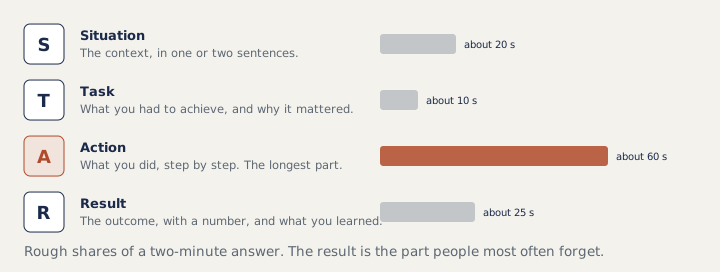
The situation is the context in one or two sentences. The task is what you had to achieve and why it mattered. The action is what you did, step by step, and it is the longest part. The result is the outcome, with a number if possible, and what you learned. Candidates often forget the result, yet it is the part interviewers tend to remember. If you have no number, describe the change: "developers started fixing failures the same morning".
Say "I" for your own actions and "we" for shared goals. The interviewer is hiring you, so they need to hear what you did, but do not take credit for other people's work.
Build a story bank
Prepare five or six true stories. Each one can answer several questions. Cover these themes: a disagreement with a developer (a colleague who writes the code) or another teammate, a bug you missed or a wrong call, a tight or missed deadline, learning a new tool quickly, something you improved without being asked, and a time you put the user first. Write each in a few STAR lines, with the numbers you can defend.
Conflict with a developer
Choose a disagreement about work, never a personal clash. A strong story shows that you talked directly and calmly, listened to the other side, used facts (the requirement, a recording, the user impact) and brought in the product owner (the person who decides what the product should do) when the decision was theirs. End with the outcome, something that improved, such as a short call before any bug is rejected, and a working relationship that stayed good.
A bug that escaped
Everyone misses bugs, and interviewers want to see ownership. Explain the impact honestly, what you did straight away (reproduce it, help measure the impact, retest the fix), why you missed it (a missing scenario, test data that never varied, an environment difference) and the lasting fix: new tests, a checklist item or a process change. Do not blame the developer, and avoid a story that shows plain carelessness.
A missed or tight deadline
The best stories show that you raised the risk early with numbers, ranked the work by risk, offered options, and let the right person decide. Then give the result and what you changed afterwards, such as checking the test environment (the server used for testing) before each test cycle.
Learning fast and improving a process
For learning, show a method: a clear goal, the official documentation, the smallest working piece first, real work soon after, and a quick review from someone experienced. For a process improvement, pick a problem others had accepted. Show your evidence (for example, fifty rejected bugs reviewed), the change you proposed, how you brought the team along, and the measured result.
"How do you keep your skills current?" often follows. It is not a STAR question, but it needs the same proof: name real habits, such as reading the release notes of the tools you use and trying new features in a practice project, then give one recent example and what you are learning now.
How to answer in an interview
Keep each story to about two minutes and let the interviewer ask for more. Use real details: tool names, numbers, time frames. Stay positive about former colleagues. If you have no example for a question, say so, and describe how you would handle it using a related experience. Never invent a story; follow-up questions expose made-up details quickly.
Common mistakes
- No result, or a result with no effect on anyone.
- Saying "we" all the way through.
- A long situation and a short action.
- A conflict story where you are right and everyone else is wrong.
Recap
Situation and task short, action longest, result always. Prepare five or six true stories and adapt them to each question. The examples in this topic are structures to fill with your own experience, not stories to repeat.
9 questions0/9 solved
| Status | Question | Difficulty | Asked in |
|---|---|---|---|
| Not started | Answer behavioural questions with STAR | Easy-Medium | Asked in: Amazon, AMD, D. E. Shaw |
| Not started | Which part of this STAR answer is missing? | Easy | Asked in: Amazon, AMD, D. E. Shaw |
| Pro+ | Tell me about a conflict with a developer | Medium | Asked in: Accenture, TCS |
| Pro+ | Tell me about a bug you missed that reached production | Medium | Asked in: Amazon, AMD, D. E. Shaw |
| Pro+ | Tell me about a time you missed, or nearly missed, a deadline | Medium | Asked in: Accenture |
| Pro+ | Tell me about a time you had to learn a new tool quickly | Medium | Asked in: Accenture |
| Pro+ | A process you improved, and the result | Medium | Asked in: Amazon |
| Pro+ | How do you keep your skills current? | Easy | Asked in: Accenture |
| Pro+ | Behavioural answers: "I" or "we"? | Easy | Asked in: Amazon, AMD, D. E. Shaw |
The first 2 questions of each topic are free. Pro+ opens every question.