
Framework · Java
Explain your framework
A clear structure for describing your framework in an interview.
Learn: How to explain your Selenium Java framework in an interview9 minute read
"Explain your framework" is the most common question in automation interviews, and often the longest answer you give. A framework here means the code and tools around your tests: how tests are organized, how browsers start, where data and settings live, and how results reach people. Interviewers use it to judge whether you built and ran a real suite or only followed one. Never describe a framework you did not use, because every detail you mention invites a follow-up question.
Know the layers first
Most Selenium Java frameworks have the same layers, whatever the company. Each layer calls the one below it:
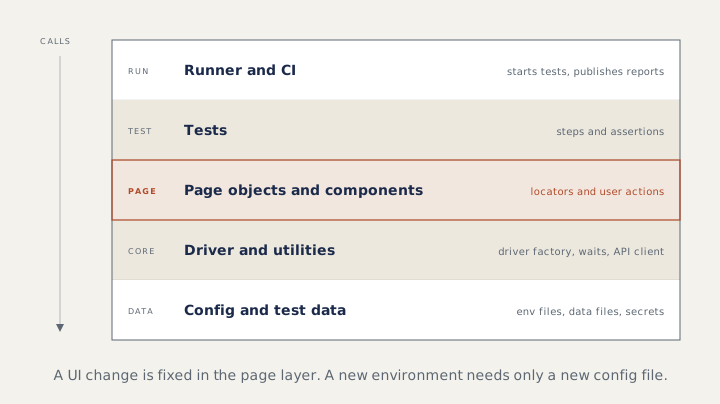
If you can draw your own version of this picture with real class and folder names, you can explain it.
How to answer in an interview: the two-minute structure
- Type and stack, in one sentence: what kind of framework and which tools.
- Layers and folders: how the code is organized.
- One test from start to finish: the clearest way to show the design.
- Data and configuration: environments, test data, secrets.
- Reports and CI: how results reach people and when the suite runs.
- Your part: what you built or improved, with one problem you solved.
A filled example
The text below shows the shape of a good answer. It is an example, not a script; replace every detail with what your project really uses. Some words in it are explained on other pages: a hybrid framework mixes styles (Page objects and design patterns), a ThreadLocal driver gives each thread its own browser, and Grid runs browsers on other machines (Parallel and CI runs). REST Assured is a Java library for calling APIs, Allure makes reports, and Jenkins is a CI server that runs your tests automatically.
"It is a hybrid framework: Java 21, Selenium 4, TestNG and Maven, with REST Assured for API set-up, Allure for reports and Jenkins for CI.
Under
src/test/javawe havetests, grouped by feature;pages, one page object per screen plus shared components such as the header and the data table; andutilswith the driver factory, a ThreadLocal driver manager, wait helpers, a config reader and a JSON data reader.A test runs like this: the suite file selects a group;
@BeforeMethodin the base test asks the factory for a driver, local Chrome or a Grid session depending on config, and stores it per thread; the test creates its data through the API, then calls page methods and asserts; a TestNG listener takes a screenshot on failure and attaches it to Allure;@AfterMethodquits the browser.The environment is chosen with
-Denv=qa, data comes from JSON through DataProviders, and passwords come from Jenkins credentials. Jenkins runs a smoke group (a short set of the most important tests) on every merge and the full regression (all tests) every night with four parallel threads, publishes the Allure report and posts a summary to our channel.My part: I added the API-based data set-up and the ThreadLocal driver manager. That let us move from serial to parallel runs and cut the nightly run from about 90 minutes to under 30."
How to prepare your own version
Trace one real test through every layer with real class names. Know your numbers: how many tests, how long a run takes, how often it runs and how stable it is. Prepare one improvement you made and one thing you would change now. Then time yourself, and stop at about two minutes.
Follow-ups to expect
- "How do you run tests in parallel?" The TestNG parallel setting and thread count, one driver per thread in a ThreadLocal, and independent data.
- "Where do you use OOP?" (object-oriented programming) Encapsulation (hiding details) in page objects: private locators, public actions. Inheritance (one class reuses another) from a base page or base test. Polymorphism (one type, many forms) through the
WebDriverinterface with different browser classes behind it. - "How do you create the driver?" A factory builds options from config and returns a local or remote driver; a manager keeps it in a
ThreadLocal; the base test creates it in@BeforeMethodand quits it in@AfterMethod(alwaysRun = true). - "How do you handle flaky tests?" Find them in CI history, reproduce, fix the cause; retries only as a tracked safety net.
The other questions in this round
The same round often asks a few related questions. Short, structured answers work best:
- "Design a framework from scratch": ask first (app type, team language, CI tool, browsers), agree the test mix with the team, then build the layers above and start with a few valuable tests running in CI.
- "What do you automate?": checks that run often, guard high-risk flows and are stable. Exploratory and usability testing stay manual.
- "How do you split UI, API and unit tests?": the test pyramid. Test each rule at the lowest level that can catch it, and keep UI tests for the main journeys.
- "Is automation paying off?": time saved minus maintenance, time from commit to result, regressions caught, and the share of failures that are real bugs.
- "A challenge you faced" or "a tool you built": situation, cause, action and result, with a number if you have one.
Common mistakes
- Listing tools without saying how they fit together.
- Describing a framework from a tutorial instead of your own.
- Forgetting CI and reports.
- Claiming you built everything when you joined a working project. "It existed when I joined; I extended it by..." is fine, and more convincing.
Recap
Know your layers, then answer in six parts: stack, layers, one test end to end, data and config, reports and CI, and your own part. Use real names and numbers, keep it to about two minutes, and expect follow-ups on parallel runs, driver management and flaky tests.
11 questions0/11 solved
The first 2 questions of each topic are free. Pro+ opens every question.